

Appalachian Foodways
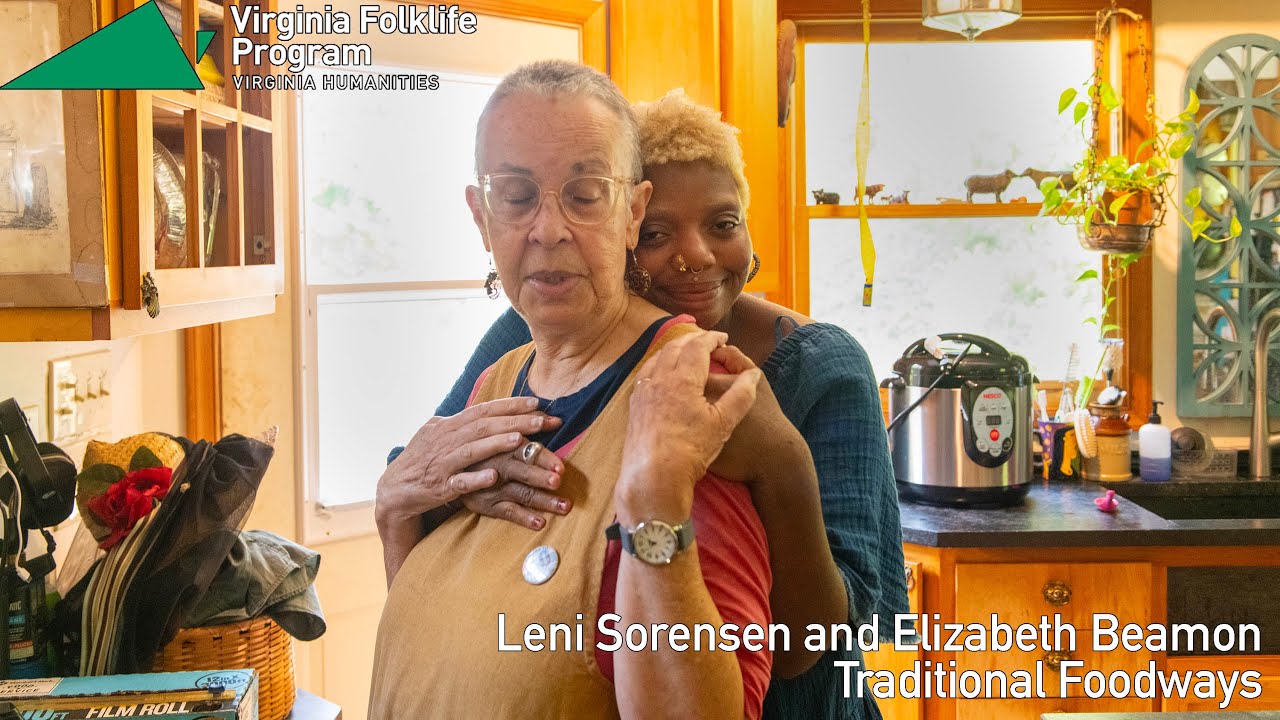
Nestled in the hills of Browns Cove, northwest of Charlottesville, Leni Sorensen’s home bursts with life.
Carved wooden bowls and statuettes dot the shelves, interspersed with metal sculptures and family photos. Begonias, pothos, and countless other plants snake their way around the room, crawling out from hidden pots. Countless books fill the remaining spaces, but the real treasures lay behind the bookmatched wooden cabinetry, handmade by her late husband, Kip: a rainbow of jars of preserves, ranging from peaches to tomato soup to venison. All of this before we even reach Leni’s vibrant garden.


At 81, Leni’s winding path through life provides more than enough stories for an afternoon visit, let alone a two-hour interview. Yet it’s clear from even a short conversation with her that, at every turn, Leni has found herself among food. At nine years old, she spent her summer days at the San Diego County Fair. With no money to spend, she talked to the cooks, the dairy workers, and the craftspeople. At home, she was left to her own devices, trying her hand at cooking dinner for her parents. Nobody ever complained because, as Leni remembers her mother saying, “nothing is more fantastic than walking into your house at 5:30 or quarter to six at night, you’ve been working all day, and there’s a meal.”
She cultivated this just-figure-it-out attitude from then on. As a younger mother, she started a farm, raised animals, and forged her path as a “pantryist” from all but scraps in South Dakota. When she moved to Virginia, now 40 years ago, she cemented her “bona fides with the local[s]” by butchering a rambunctious calf in her front yard. This attitude is one of the many things Leni and Liz share, and something that Leni finds uniquely admirable in Liz, who “is really open to the fact that you can just make it.”
In fact, after a lunch of sandwiches and lots of canned goods like escabeche, watermelon juice, and Leni’s auntie Vi’s famous pickles, Liz stained her hands dark red pitting cherries for an infusion she had been wanting to try.

Elizabeth removes cherry pits. Leni holds a fire starter made by Elizabeth. Elizabeth wipes the rim of her chicken broth jar with vinegar.


Liz, a self-avowed old soul at the edge of the Gen Z and Millennial divide, credits her mother, a professional baker and “fantastic cook,” and the Food Network — Alton Brown especially — for cracking open the world of food for her. Liz liked Brown and his show, Good Eats, for making cooking accessible: He explained the science behind cooking and how to apply it when, inevitably, your circumstances are different than those shown. Before Alton Brown, Liz remembers her mother’s cabbage soup, gumbo, and enchiladas — so good she would weep when she had a cold because it meant she couldn’t taste them.
Leni and Liz met because a mutual friend of theirs knew that Leni needed an assistant for her historic dinners, telling Liz, “I think she’s you, but old.” Liz, who has worked as an actor, a cook, and a caterer, easily complemented Leni. Leni saw in Liz more than someone to simply carry dishes. She noted how Liz could offer substantive, no-frills additions to Leni’s dishes: Liz added a crucial dash of Mary Randolph pepper vinegar to Leni’s tomato soup, the recipe recovered from the historic cookbook Leni is making her way through.

Now, as Leni’s Virginia Folklife apprentice, Liz is advancing her skills in preservation (especially pressure canning) and traditional methods of cooking, including outdoors over an open fire.
For Liz, food is a tool essential to liberation, a centerpiece around which people can reconnect as well as a universal way to improve people’s security and stability. In this, Liz and Leni align; Leni encourages preserving food as a way for farmers and even gardeners to build their own security. Leni has also learned that connecting over food is easy because food has a way of bringing out the best in people.
“You can find almost any person, some old Paw Paw, she said. “It doesn’t matter who he is, he’s going to tell you about what his grandma made and what his grandchildren are doing.”
“Every time you eat, you’re determining to continue for a little while, whatever that means — whatever your little while is.”
Leni Sorenson, mentor artist in our 2024–2025 Folklife Apprenticeship Program
Liz has learned the same lesson, recalling how, in her days as an actor, her apartment would turn into the cast’s social hub, a place to go between rehearsals where there was always plenty to eat. Sharing food and cuisine, Liz said, is often the first step in softening relational tensions and breaking down cultural barriers, because “you might not appreciate your neighbor, but I guarantee you appreciate the food that comes from their culture.”

Two kindred spirits who love to host dinner parties, Liz and Leni are deeply practiced in connecting over food and appreciate the fulfillment of nourishing people. Even as a child cooking for her parents or her classmates, Leni learned that “nothing is as rewarding as to feed people, and have them like it, really like it because they wanted [it], and not merely because they like it, but because they needed it, and you supplied it.”
As a food historian, Leni will help chart the path for both preservation and historic cookery, aiding Liz in these practices of self-reliance and following her own long-held dictum, “each one
teach one.” For both women, food is clearly the foundation on which we build the rest of our lives. As Leni recalls, “somebody said eating is the promise that life will go on,” and, just as eating is the promise that life will go on, preserving food is the promise that it will go on for even longer, through the winter, through heavy storms, through lost jobs, and through other crises.
In Leni’s own words: “Every time you eat, you’re determining to continue for a little while, whatever that means — whatever your little while is.”
Philip DiMeglio was a Summer 2024 Virginia Folklife Program intern and is currently teaching English in Sevilla, Spain. Philip studied furniture craft and design at the Vermont Woodworking School and graduated from UVA with a BA in Global Studies and Economics in May 2024.


