

Plena Mayagüezana (Panderetas, Requinto)
Plena music is tied to Puerto Rican identity.
For Maurice “Tito” Sanabria, studying the distinctive style of plena from his hometown of Mayagüez, situated on the island’s western coast, is also a way to connect with his family’s roots. Like his parents before him, Tito was born in the city and raised in the bordering towns of Cabo Rojo and Hormigueros.
For the last twenty years, Tito has lived in or near Richmond. He and his father Maurice play in a plena and bomba band called Kadencia. Tito’s instrument is the requinto, the smaller pandero (hand drum) that improvises over the primary rhythm.
After seriously loving Kily Vializ’s 2020 album, Boricua y de Mayagüez, Tito decided to reach out to the artist, to see if he would be open to teaching him more about plena Mayagüezana (Mayagüez-style plena).
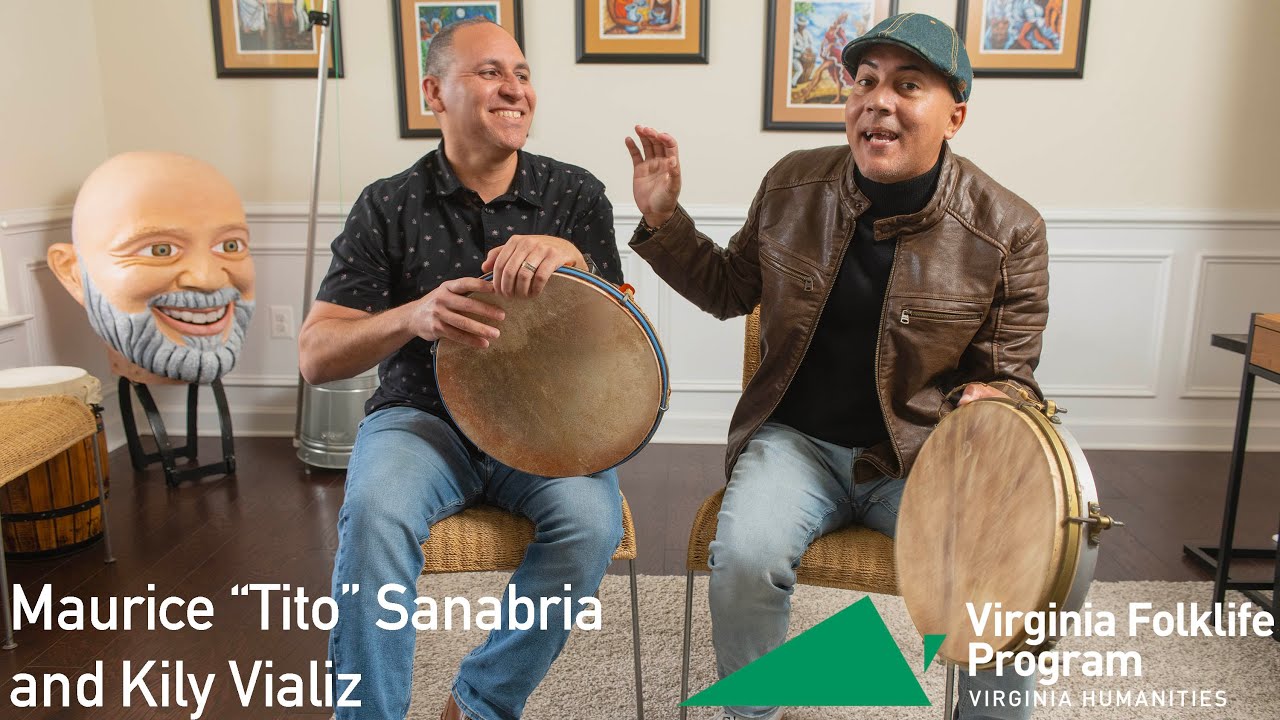
At first Eric Miguel Vializ Montalvo, who performs as Kily Vializ, was hesitant.
“I was afraid to accept his invitation because the few people who have this knowledge, we are sometimes suspicious,” he said. “We have to protect it, but at the same time we also have to try and promote it. But I accepted the challenge.”
Kily is a plenero; he lives and breathes the music.
“Plena is my life. Both my mom and dad played plena,” he explained. “My mom sang and wrote music. When she was pregnant with me, she took guitar lessons. She’d place her guitar on top of her belly. Same when she played the panderetas, she would place her pandereta against her belly, and I was in there.”

Plena is based on the rhythms of the pandero and blends African, Indigenous, and European influences. Its instruments are percussive: the güiro, perhaps Puerto Rico’s oldest instrument (a hollow gourd with carved ridges played with a scraper), the marimbula (box with metal twines, plucked as a bass), the tumbandero (washtub bass), timbita (small drum), and typically three panderos. It was called el periodico cantado (the sung newspaper) for its narrative lyrics.

“Plena is the first genre of music developed and born after the United States invaded Puerto Rico in the Spanish American War in 1898,” Kily explained. “It is through plena that people could express the changes in society that were happening around them as a result of the invasion.”
Plena is popular today with young people in Puerto Rico, but Kily said plena Mayagüezana is being lost, that people forget about Mayagüez, or think the style sounds old-fashioned or dated.
Plena Mayagüezana is typically played with two panderos instead of three, called panderetas. The larger pandereta is called la hermana (sister) or segundo (second), while the smaller, requinto pandereta is called la prima (cousin, or number one). Players use all their fingers, and hit the drum from the back as well as the front.
The resulting sound is a little more intimate, giving more focus to the singer. Two styles of song are typical in plena Mayagüezana: El lamento, a slower, somber ballad, and el trabalenguas, the tongue-twister.

After agreeing to apprentice Tito, Kily told him: “We have to do this the right way, we’re going to do it with panderetas de olla.”
Kily visited Wilfred “Kichy” Morales, one of the few remaining artisans who still makes panderetas the traditional way, out of old aluminum pots (the heavier the better). Kichy made Tito a pandereta de olla in time for his first visit with Kily in August 2023.

While together, Kily took Tito through the neighborhoods that are important to plena Mayagüezana. They visited one of the most famous, Dulces Labios, home to legendary pleneros and pleneras. Local businesses host weekly plena gatherings, friends and family bring chairs, snacks, and play dominoes. And as Kily said, “culture is still being made here on a monthly basis” at the public plenazos held under a giant pandereta.
The two also visited plena players and scholars Javier Muñiz and Alberto Galarza, who told Tito: “Mayagüez-style plena is like the daughter of bomba. Plena was born in the sugar cane plantations just like bomba. It is the music of the periphery and the barrios.”
Taking Tito on as an apprentice challenged Kily to revisit the teachers, videos, and books that formed the foundation of his musical knowledge. It has also reinvigorated his commitment to the practice.
“Tito awoke in me that urgency to fight for Mayagüez-style plena in Mayagüe,” Kily said. “If we are going to talk about Mayagüez-style plena, we have to start at home. We can do so elsewhere but after we do so at home.”
“This apprenticeship has stretched my boundaries as a musician,” Tito said. “It’s made me fall in love with this style of plena. And it’s made me reconnect with my hometown, with my people. It’s made me learn more about my Mom and my Dad.”
One of the most rewarding experiences during their time together was Tito’s visit to Mayagüez in January 2024, when he had the opportunity to play alongside Kily and other greats in a neighborhood Three Kings Day celebration. He was welcomed in his birthplace as a fellow plenero.


Tito’s interest also gives Kily hope. “We have to make sure that our traditional Mayagüez-style plena does not disappear and does not die out,” he said. “This is a process that may be slow. It can take a long time. But as I told you, we are going slow because we are going far.”
Tito’s father, who is looking towards retirement, recently made him band leader for Kadencia’s comparsa (small ensemble).
“Now I feel like I have a responsibility not only to teach, preserve, and promulgate Mayagüez-style plena, but to practice it, and incorporate it into Kadencia and my personal projects,” Tito said.

“The hard part is planting the seed,” Kily said. “Taking care of the plant. Watering it. And we may never see its fruit. It may be others who will feed from it, get nourishment out of it, and benefit from that fruit.”
Their time together inspired them to grow the plena Mayagüezana catalog. During their apprenticeship, Tito wrote two original songs, which he plans to record with Kadencia and release in 2025. Kily also composed a new trabalenguas he plans on recording soon. Pa’lante plena Mayagüezana!
Visitors to the Richmond Folk Festival on Saturday, September 28, 2024 will have the opportunity to see Tito and Kily perform their original plena Mayagüezana compositions together in the Virginia Folklife Area.
This article was written using a Virginia Folklife Program interview with Tito and Kily on December 3, 2023, as well as interviews recorded by Michael Sanabria when Tito visited Mayagüez in August 2023.


