

Broom Making
Dozens of time-worn carpentry tools decorate the raw plank walls of John Alexander’s workshop in Independence, where he has spent the last year teaching Erin Simons, of Wytheville, the steps to handcraft a variety of brooms through our 2024–2025 Folklife Apprenticeship Program.
Both John and Erin bask in the beauty and practicality of the brooms they hand craft: Whether they’re making a typical upright broom for floor sweeping or a smaller whisk, called a turkey wing for all kinds of cleaning chores, each promote the inherent function and artistry of the broom.
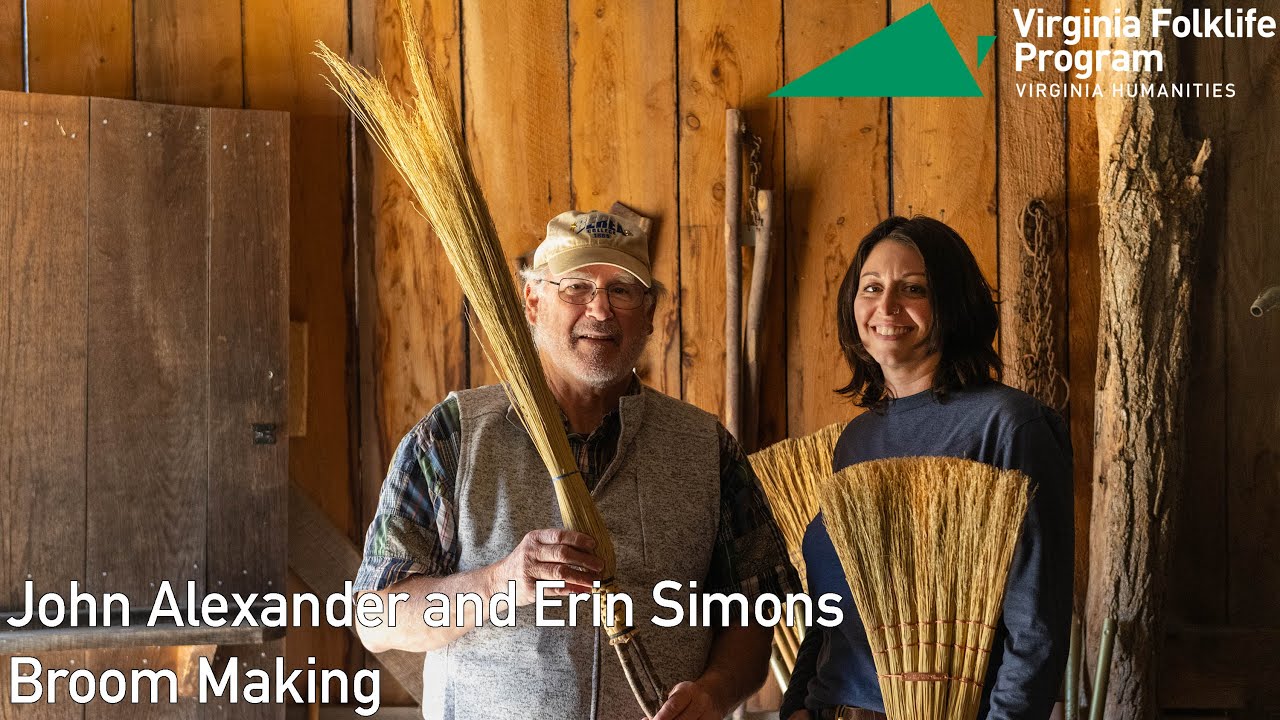
John began creating one-of-a-kind brooms fifty years ago during his undergraduate days at Berea College. (Students at Berea, a liberal arts work college in Kentucky, have balanced craft making with their studies since its inception.) Although Erin has been making brooms for a fraction of the time, she relishes the care and coaching John gives while mentoring her.

“At the time I started, there was only one book [about broom making],” Erin said. “I didn’t know where to find material, I couldn’t find anything on YouTube. There was nothing available.”

When she and John connected over their craft, they found they had a lot in common: both married to their high school sweethearts, parents to large families, skeptical of the origins of some broom folklore, and deeply attached to their Appalachian ancestry. They see a through line from that heritage to their desire to put everything to good use.
“I think what is really cool about broom making, and just Appalachian ingenuity in general, is repurposing items into brooms,” Erin said. “John’s made brooms out of musical instruments and golf clubs and all sorts of things… I’ve used beer tap handles and chair legs and croquet handles.”
John concurred: “I had a gentleman bring me porch spindles because they were tearing down his home place, and he wanted brooms for each of his kids made off the porch spindles.”
Perched on wooden stools, firm hands stretching inky string taut as they weave it around and through the broom’s bristles made from broom corn, the pair reflected on their chosen art.

“[The broom is] such a humble tool, and you can put your whole self into it when you’re making it from start to finish,” Erin said. “It is something that is made by hand. It’s harvested by hand. It is constructed by hand. And then, it is a hand tool. […] It’s like it almost carries its own story and its own history.”
“I like something that’s functional,” John added. “I like the fact it is a piece of art as well… It’s a very low overhead craft to get into. You need a sharp knife, strong string, broom corn, and a stick, and you can make one. You don’t have to go out and buy thousands of dollars’ worth of tools to get into the broom business.”

Erin holds three brooms she crafted.


John and Erin, both former schoolteachers, come from long lines of makers and creators. “Mom was a teacher, dad was a farmer and sold insurance so he could afford to farm,” John said. “But like a lot of kids back in those days, you made stuff, and if you weren’t building fences, you were in the shop tinkering and tearing stuff apart. Whether it was apple butter or Aunt Jo making biscuits in the top of the flour barrel, not using the bowl, just patting out the dough — I mean, we grew up in an era when you literally used everything at butchering time but the squeal.”
“At the time I started, there was only one book [about broom making].”
Erin Simons, broom making apprentice in our 2024–2025 Folklife Apprenticeship Program
Likewise, Erin comes from a multi-generational wood working and artistic family. Before broom making, Erin, who creates from her home workshop: Laurel Ridge Studios, preferred “fine art, drawing, painting, watercolor, things like that.”

“My dad’s side were more of the craftsmen, craftswomen with knitting, quilting, chair caning, woodworking, those types of things,” Erin said. “Dad was a woodworker, his dad was a woodworker, and his granddad was a woodworker.”
They cherish bringing broom making to wider audiences in their communities and across the Commonwealth. Their partnership began in 2023 as fellows in the Central Appalachia Living Traditions through the MidAtlantic Arts initiative. John demonstrated at the Virginia Folklife tent at the 2023 Richmond Folk Festival and he frequently teaches broom making at the Matthews Living History Farm Museum in Galax.
This spring, Erin left her high school art teacher career and joined the staff at Abingdon’s ‘Round the Mountain Artisan Network. As an artisan engagement specialist, she works to connect, support, and help grow the artisan community of Southwest Virginia.
Examples of vintage/heirloom brooms made by other broom makers (left to right: Ogle family, unknown, and Berea College students).


The setting sun bounced on the stray broom corn scattered in the workshop as the pair continued to chat about anything and everything, including the finer nuances of color in a broom. (Erin favored incorporating dyed broomcorn and multi-hued strings, her preference exposing her fine arts background.) As the conversation ended, their focus shifted to what’s next: showcasing their craft live at the Virginia Humanities 50th Anniversary and Folklife Celebration on June 14, 2025, at the Jettie Baker Center in Clintwood.
There, their work won’t just tell a story — it’ll bring a centuries-old Appalachian tradition vibrantly into the present, inspiring a new generation to keep the art alive.


