

Gourd Banjo Building
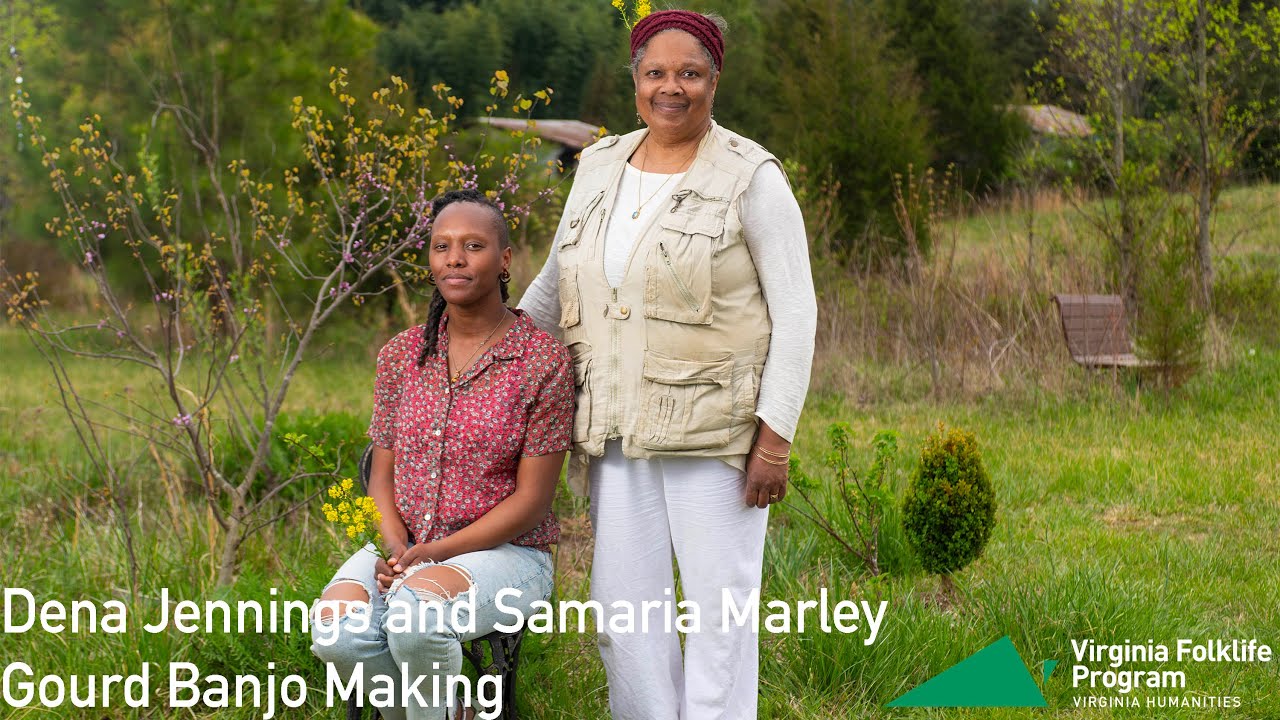
Dena Jennings and her apprentice Samaria Marley have much more in common than their interest in building gourd banjos.
Both know how isolating it can feel to be a Black woman playing in folk music spaces, and both are delighted at the recent spotlight on Black women and country music. (In 2023, Rhiannon Giddens won the Pulitzer Prize, in 2024 Tracy Chapman’s performance at the Grammys stole the show, and Beyoncé released Cowboy Carter, challenging genre conventions.)
“It’s kind of wonderful,” Samaria said.
“I hope that the future will see this as one brief shining moment that feeds into what becomes mainstream and standard,” Dena said.
Dena was raised in Akron, Ohio, the youngest daughter of a Goodyear Tires businessman and a banker. Her father grew up in Georgia, and his roots are in Nigeria and eastern India. Her mother grew up in a holler on a farm in the Cumberland Gap area of Appalachian Kentucky, in a family that was active in the Pentecostal church. Dena spent summers in Kentucky with her cousins. She remembers taking the Greyhound Bus and bringing her guitar, because everyone in her mother’s family made music.
“You were in church all summer long, playing music and singing,” Dena recalled. “If you didn’t play it, you learned to play it. When you went home you’d eat, then sit out on the porch and play all night.”

Dena Jennings


When Dena wrote songs and performed them in coffee shops in college, she made music in the tradition she was raised in. Her friend, who was studying ethnomusicology, told her she was playing banjo songs on the guitar. He led her to an album of field recordings made in Black communities in the 1930s and 40s. Dena heard the songs she knew from church, and for the first time, the term “Black Appalachian.”
“You don’t know that you are part of a genre of music if that is all you hear,” Dena said. “I always wondered why my family’s music sounded like ‘Hee Haw’ and not like James Cleveland or Mahalia Jackson.”
Not long after that, Dena bought her first banjo, a small rim model signed by luthier Jeff Menzies. She loved the sound and feel of it, and continued to play on Thursday nights as she opened her first medical practice in Kent, OH. Eventually, Dena sought out Menzies, and traveled to Canada for a workshop. She built her first gourd banjo and fell in love with the craft.

When she was semi-retired from practicing medicine, she seized an opportunity to move to Ontario and apprentice with Jeff for four years. When he and his family moved to Jamaica, Dena bought his studio equipment and opened her business, Story Gourd Workshop, in Cookstown, Ontario. In one half of the building she built instruments and taught workshops, in the other she served tea.
In 2013, newly married, Dena and her husband moved to Nasons, Virginia, to live on his 100-acre farm, where they practice a neo-monastic lifestyle that de-emphasizes materialism in favor of living in tune with the land, practicing meditation, and cultivating intentional community.
“Every gourd tells a story, from seed to vine, how it twirls around itself on the trellis, to the little grape-sized gourd that starts to grow, and keeps expanding and expanding. Once you carve it and make something out of it, when it is dry and resonant, it tells even more of a story.”
Dena Jennings, physician, musician, luthier & master naturalist
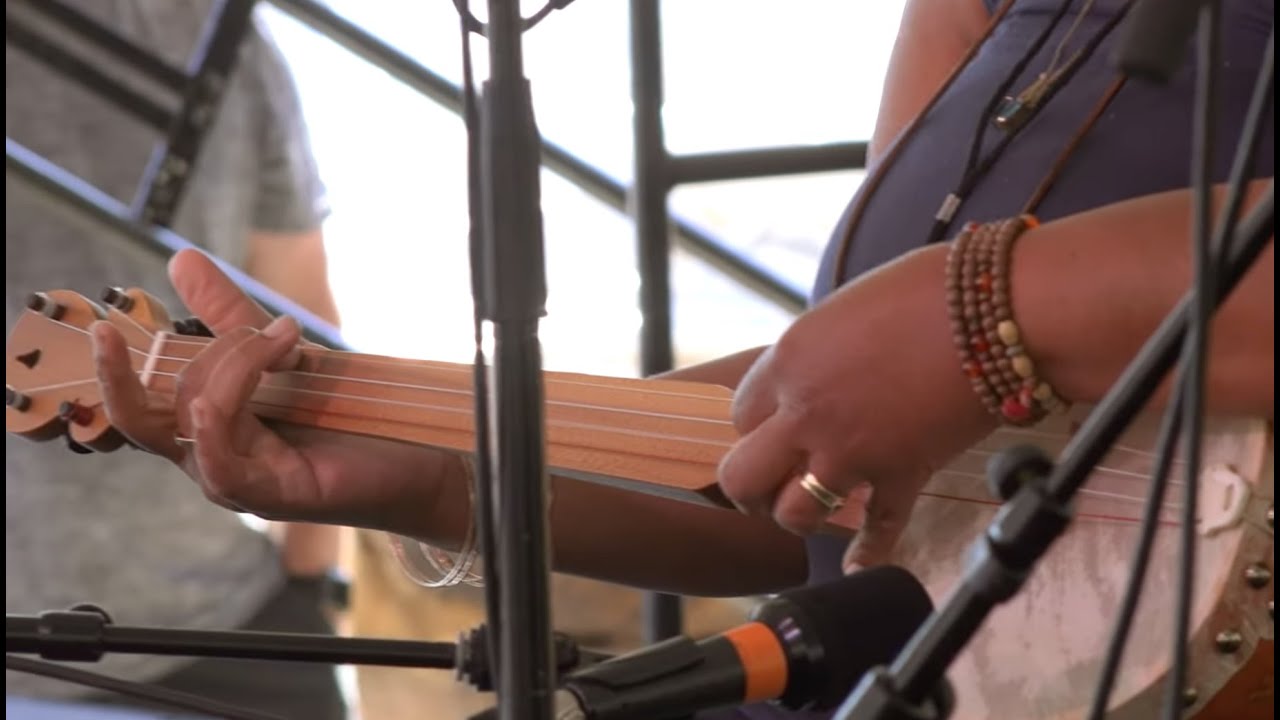
Dena now makes string instruments using gourds she grows, with necks and pegs carved from maple, cedar, juniper or persimmon—all harvested on the farm. By doing so, she is peeling back the layers of American old-time, bluegrass, gospel and country music traditions, back to the 18th-century, when enslaved Africans were first documented playing gourd banjos they had made, based on instruments from home.

Dena is resurfacing this lineage on her terms and honoring the deeper roots of her musical lineage.
“The instruments that I build today are based on what happened to those instruments when they came here from Africa, by way of the Caribbean, into Appalachia,” Dena said. She is certain that enslaved women braided gourd seeds into their hair, safely bringing this most useful of vegetables to North America.
By apprenticing with Dena, Samaria is not only learning how to transform a seed into an instrument, but she is also tapping into the deeper roots of her own musical identity. Her Texan family traces their roots to Virginia and Kentucky, and she attributes her gravitation towards folk music to this inheritance.
“I don’t know if anyone in my family played the banjo, but there are some things that you just feel in your bones,” she explained.

Like Dena, Samaria is a healer. She is a musician, a farmer, and an herbalist. She farms Juniper’s Garden with her family in Maryland and runs the DC Mutual Aid Apothecary. Through the Virginia Folklife Apprenticeship, she is learning to build her first gourd banjo with Dena, and she also hopes to make her oldest daughter, who plays the violin, a gourd fiddle.
“I really hope that someone in my family down the line will be playing this instrument and think, ‘My great-grandmother made this’—that it can have that longevity,” Samaria said.

Last September, Samaria and her family attended the 6th-annual Affrolachian On-Time Music Gathering on Dena’s farm. In 2018, Dena founded “The Thang” as a retreat for black string band musicians and their allies, with a focus on rest, rejuvenation, and creative encouragement. “Some of us were a little frustrated with the music camp scene, and felt like we wanted a place where we weren’t on all the time as a showpiece, where we could relax,” Dena said.
In 2019, public concerts were added Friday and Saturday nights, but the intimate and supportive vibe remains. (This year’s Affrolachian On-Time Music Gathering is September 20 and 21.)
“My daughter brought her violin [to the Thang] and I think that was amazing exposure for her,” Samaria said. “Just to see other Black people playing the fiddle and getting to play along a little bit.”


Funds raised from The Thang go to Dena’s nonprofit, Imani Works, into a mutual aid fund to support Black Appalachian music. Through Imani Works, Dena teaches conflict transformation workshops, cultural appropriation training, and offers other experiences in support of human rights.
“You have 30 human rights,” Dena said. “One of them is the right to your culture.”
Along with building gourd instruments, Dena and Samaria are also planting seeds for future generations of Black women to continue to claim, and transform, their musical roots, ensuring each generation can transform the tradition according to their vision, voice, and the needs of the moment.
“These modern gourd banjos that we’re making—they might not look like this ten years from now,” Dena said.
This story was written using Virginia Folklife Program interviews with Dena Jennings on September 7, 2022 and September 23, 2023, and with Dena and Samaria Marley on April 17, 2024.


