

Piedmont-style Blues
In his seminal 1963 text Blues People: Negro Music in White America, Amiri Baraka examines the history of Black Americans from the time of slavery onward through the lens of Black music, arguing that its evolution directly reflects the changing experiences of Black Americans.
The blues, he writes, arose as a response to the conditions Black Americans faced in the post-slavery era, particularly in the rural South; early blues frequently took the form of a loose narrative, incorporating spirituals, work songs, and field hollers while describing the struggles wrought by racial discrimination.
“Blues is not just a music pattern or music theory, or a musical chord,” said Lamont Jack Pearley, applied folklorist and founder and editor of the African American Folklorist magazine. “It is a culture. It is a tradition. It is a kinfolk. It is a daily interaction. It’s vernaculars, it’s language.”
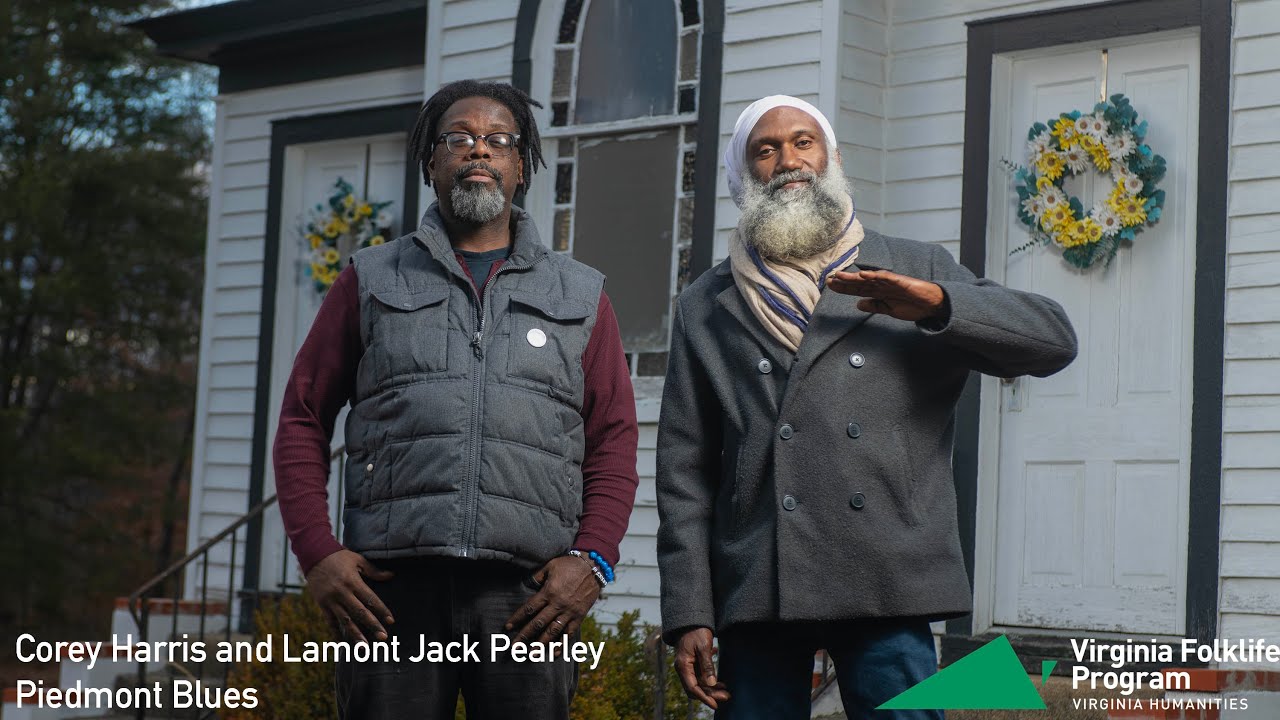
For Lamont, who resides in Bowling Green, Kentucky, Baraka’s theory of Black Americans as “blues people” is a deeply held belief: he describes his work as “specifically for the uplift and betterment of my particular folk group: what I like to call the blues people.” In addition to producing African American Folklorist, he runs the nonprofit Jack Dapper Blues Heritage Preservation Foundation.
A self-taught guitarist, Lamont is also pursuing a PhD in Ethnomusicology at Indiana University. As part of our 2023–2024 Folklife Apprenticeship Program, he has spent the last year apprenticing the fundamentals of Piedmont-style blues with Corey Harris of Charlottesville, an accomplished blues musician who has contributed nearly 20 albums to the canon over the past three decades.
“Lamont’s always making strides to get better, and he’s conscientious to all the little details in music, because it’s not something that you can just open up your case and start playing from day one,” Corey said. “So, what I’m showing him is [how to add] some things on to what he’s already articulated for himself.”
“[I hope] that people can see value in themselves. Because that’s what I’m trying to do: see value in myself and bring it out and share it with the world. I want to see that from other people.”
Corey Harris, musician & 2023–2024 Folklife Apprenticeship Program mentor artist
Corey, like Lamont, sees the blues as both a musical study and a cultural practice, an outward expression and an embodied experience. In 2003, he was a featured artist in (and the narrator of) Martin Scorsese’s Feel Like Going Home, which traces the evolution of blues from West Africa to the American South. In 2007, he was awarded a MacArthur Fellowship — commonly referred to as a “genius award” — in support of his efforts to revive the Mississippi Delta blues tradition. He’s currently a PhD candidate in UVA’s music department, studying music analysis, history, and criticism.
“[This apprenticeship is] about putting the music, and the practice of music-ing, into context — into historical context, into social context, into cultural context — and realizing none of this is happening in a vacuum, and it is a reaction to continued events in history,” Corey said.

Primarily played on guitar, the Piedmont blues style is characterized by its fingerpicking, often compared to ragtime or early jazz piano. Musicians play alternating bass lines with their thumb, while their fingers play melody and syncopated rhythms on the higher strings, creating a lively, bouncy sound. Virginia is home to some of the greatest Piedmont blues artists of all time, including John Jackson, Daniel Womack, Turner and Lynn Foddrell, and John Cephas who were part of the Virginia Folklife Program’s Piedmont Guitarists Tour in 1991 and 1992.
“If you were to contrast it with Mississippi [Delta blues], Mississippi has a funk and a despair to it that — it’s not completely lacking, but it’s less pronounced in the Piedmont,” Corey said.
“My background in blues is playing the despair and rhythmic Delta Blues,” Lamont added. “So, my pattern was usually just on the sixth string, which is the bass string, and then the bottom string. What Corey has done is open my technique and understanding to alternate bass picking, which is something I wasn’t doing before.”
In honor of his blues hero, Son House, Lamont also typically wore his slide on his ring finger. Corey encouraged him to place it on his pinky instead, which Lamont said added “another dynamic to the playing” and allowed him to emulate artists like Muddy Waters.

Corey and Lamont visited gourd instrument maker Dena Jennings, right, at her farm studio in Nasons, where she puts on a gathering of black musicians called The Thang. In honor of his blues hero, Son House, Lamont typically wears his slide on his ring finger.


“When you learn on your own, you reach a plateau,” Lamont said. “I can really narrow it down like this:
“There’s a song that I love by Son House, the original Preachin’ Blues [recorded by Alan Lomax in 1930]. I’m looking up on YouTube how to play this, and who do I find playing it but Corey Harris. This was many years ago. The first thought I had was, well, maybe I should put this guitar down because I’ll never be able to do that. The only other person I saw hit anything to that level of blues note for note was Taj Mahal—there’s very few people that could do it, and these gentlemen can do it. So, I just knew: one day, I’ll be able to ask him to teach me to play that song. Now, we didn’t get to that song yet, but hopefully, we’ll be able to.”
“As the world progresses, we are losing a lot of these cultures, a lot of these ways, a lot of this knowledge from all over the world,” Corey said. “[I hope] that people can see value in themselves. Because that’s what I’m trying to do: see value in myself and bring it out and share it with the world. I want to see that from other people.”


